Photographing the penguin colony on Magdalena Island
On Magdalena Island the penguins walk right up to the trail, so the photos come easily. What spoils them is wind and spray on the lens. Cold batteries spoil a few more, as does the urge to lean too close. These nine tips cover the hour ashore and the ride past Marta Island.
The camera you already carry
1. A phone works, a short zoom helps
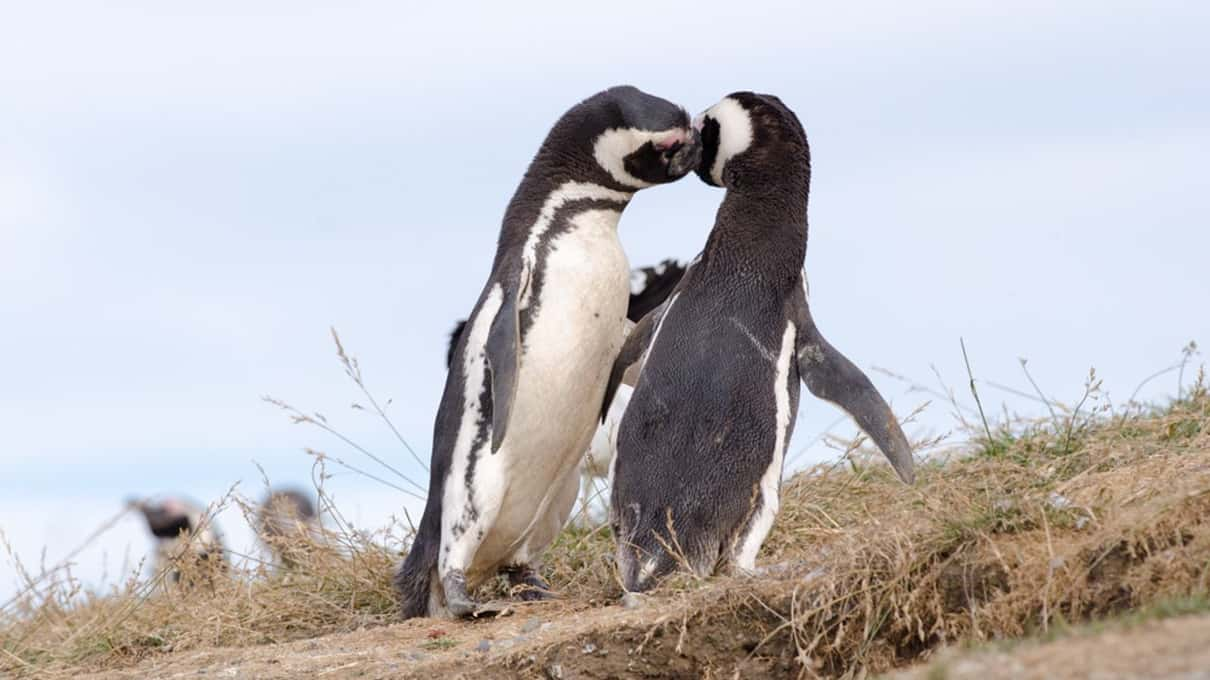
The Magellanic penguins on Magdalena often stand a few steps from the trail, and some cross it in front of you. A modern phone handles that distance well, so nobody needs to buy gear for this trip.
A camera with a short zoom, something like 24–105 mm on a full-frame body, adds reach for a bird at the far edge of the burrows. A heavy telephoto stays at home here, unlike on the king penguin day, where the birds are watched from a distance.
Our Magdalena or king penguins guide compares the two colonies, including how close you get at each. The distance to the birds decides the lens far more than the camera body does.
On the trail between the ropes
2. Get low, but stay on the path
Penguin photos taken from standing height look down on the birds and flatten them. Crouch so the lens sits near their eye level, and the pictures change at once.
Do that on the marked trail, never by stepping over the ropes. The path is about 800 m (half a mile) long according to Caminos' listing, and the ground beside it is full of burrows that collapse under a careless foot.
3. Burrow shots without leaning over
A penguin peering out of its burrow makes a lovely picture, and many burrows sit right beside the trail. Wait for one to show its head rather than leaning over the rope to look inside.
Zoom in a little or shoot from a step back. A bird crossing your path gets right of way, and our walk along the lighthouse trail explains the etiquette on the way up.
Morning light and the lighthouse
4. Use the lighthouse as a backdrop
The red-and-white lighthouse at the top of the hill, built in 1902, is the island's landmark. Frame a penguin in the foreground with the tower behind it, and the picture says Magdalena without a caption.
Shoot from lower on the slope so the tower rises above the grass line. A bird in sharp focus with a softer lighthouse behind reads better than both small and sharp.
5. Morning light on the early boat
The early departures land you on the island while the sun is still low. Solo's Viator listing gives a 6:30 am start in town, and Caminos sails at 6:00 am, both well before the harsh light of midday.
Low sun gives the black and white plumage some shape instead of hard contrast. It also tends to arrive with calmer water, since the wind on the strait is often stronger later in the day.
The early speedboat with a camera stop at Marta
Solo Expediciones lands you on Magdalena in the morning light, then circles Marta Island for the sea lions. It rates 4.6 from 700+ reviews on GetYourGuide and 4.5 from 100+ on Viator.
Wet lenses and cold batteries
6. Carry a cloth for the lens
Spray from the crossing and drizzle on the hill leave small drops on the glass, and every photo turns soft. A microfiber cloth in a dry pocket fixes that in seconds, and a tissue smears salt instead.
Wipe the phone lens before each burst of photos, not after you notice the blur. A lens hood or a cupped hand also keeps sideways rain off the front element.
7. Keep the battery warm
Cold drains batteries fast, and a phone at 40 percent in a hotel room can shut down on a windy hilltop. Keep it in an inside pocket between shots, close to your body.
Charge everything the night before and bring a small power bank for the phone. A spare battery for a camera weighs little and saves the walk back down to the landing.
Rules your camera has to follow
8. No drones, no flash
Caminos' rules for the island rule out drones, and the colony is a protected area, the Los Pingüinos Natural Monument. Leave the drone at the hotel, since a buzzing machine over nesting birds is the quickest way to upset a guide.
Turn the flash off as well. Daylight is plenty for every shot on the island, and a sudden burst of light startles birds that are trying to guard eggs or chicks.
Touching and feeding are off limits too, and keeping your distance makes better photos anyway. A bird that feels safe goes back to preening or calling, which is the behavior worth catching. Our guide to the penguin season covers when the chicks appear.
Sea lions from a moving boat
9. Use a fast shutter at Marta Island
On Solo's tour the boat spends about 30 minutes around Marta Island, where over 1,000 South American sea lions haul out, per the listing. You watch from the deck, with the boat rocking under you the whole time.
Set a fast shutter speed, around 1/1000 s if your camera lets you, or hold the phone's shutter for a burst. Brace your elbows on your body or the rail, and keep one hand on the boat when it rolls.
The rocks also hold cormorants and skuas, and dolphins are possible on the crossing. Our Marta Island sea lion guide covers what you may see, and our packing guide for the island lists the gloves that keep your fingers working.